|
|
Facial tics are
characterized by sudden, seemingly involuntary muscle
contractions of entire muscle groups in the face. These
contractions are often repetitive in nature, and appear to
have no real purpose.
Common tics are exaggerated eye
blinking, squinting, nose wrinkling, facial grimacing or
even vocalizations such as throat clearing or grunting. Tics
often manifest themselves during childhood, and often
resolve as a child ages. This is not always the case,
though, and many people continue to suffer from tics as they
enter adulthood.
Tics often increase in frequency as an individual feels
tension or discomfort. People who suffer from tics report
they are able to sense a tic as it approaches. Often being
described as an overwhelming feeling of tension and the wish
to perform the tic to break the tension; somewhat akin to
the approaching urge to yawn or sneeze which relieves the
sufferer. Controlling a tic can cause tension, which can
lead to the onset of another tic. Tics are often described
as being involuntary, but research and reports from
sufferers indicates they are indeed voluntary motions that
can be controlled by the sufferer.
A tic can manifest as a simple tic, as in facial
grimaces, mouth twitches, or grunting or can be more
complex such as is often seen in Tourette syndrome. Simple
tics are more common than complex tics, but can be just as
devastating to the individual; while a facial tic does not
cause physical pain to the sufferer, it can often cause
social problems or mental distress.
Children, in particular, can have a difficult time
dealing with a tic due to mocking from other students,
or teachers that don't fully understand the difficult
situation the child is in. While tics are often described as
not being totally involuntary, control of a tic is difficult
to establish, especially in children. Children often do not
establish the skills to recognize a tic onset as well as an
adult.
Adults can also face grave difficulty in their lives
when dealing with a tic. Social problems are commonly
experienced, and even when tics are generally controlled the
adult can become quite exhausted by the continual need to
identify the onset of and control the tic impulse. Adults
and children alike may suffer from self-worth
or self-esteem issues due to their constant suffering
from a disease that often causes them to become social
outcasts.
Relieving an individual from the distress of a facial tic
can be a life-changing experience. Self-esteem often
improves, and social anxiety is no longer a force holding an
individual back from experiencing a full life. In children,
relieving a tic may allow the child to develop with less
stress and have a happier childhood.
Over the years, many treatments for tics have been applied
with varying degrees of success. Counseling or psychotherapy
can help uncover emotional causes of a tic, and may help an
individual understand better how to combat the urge to
perform their tic. Mild sedatives and other forms of
medication are sometimes successful in cases of simple tics.
These medications often come saddled with unwanted side
effects, so many people seek alternative treatments.
Hypnosis and NLP (Neuro-Linguistic Programming) methods have
been developed expressly for the purpose of dealing with
facial tics. Since facial tics are not strictly involuntary
in nature, these treatments aim to change the sufferer's
unconscious response to the onset of a tic episode such as
facial grimacing or throat clearing. In most cases this can
be accomplished by allowing the subconscious mind to avert
the onset of the tic. In some extreme cases, however, the
sufferer's response will be redirected to some innocuous
portion of the body such as twitching a toe instead of
facial muscles.
Facial tics can be an embarrassing life-affecting malady.
Children and adults alike can suffer greatly from the
presence of a facial tic such as eye blinking, squinting,
mouth twitches, facial grimaces, nose wrinkling, or
grunting. Eliminating a facial tic can prove very beneficial
to the sufferer.
Although many treatments have been developed to combat
facial tics, Hypnosis and NLP aim to utilize natural
unconscious methods of redirecting the tic response.
This type of treatment has great benefit over other methods
such as psychotherapy, which may not treat the tic behavior
at all, or attempt to modify the conscious response to tic
behavior.
Hypnosis and NLP also do not suffer from the unwanted side
effects of drugs. This beneficial method of treatment can
also reduce stress and anxiety in the sufferer's life,
thereby both reducing the impulse to form a tic and proving
a benefit in everyday life. Due to these factors, Hypnosis
and NLP are often the safest, most preferred methods of
treatment for tic sufferers.

© Copyright © 2007 By Alan B. Densky, CH. This document may NOT be re-printed without permission. All Rights Reserved.
We are happy to syndicate our articles to approved websites.
Alan B. Densky, CH is
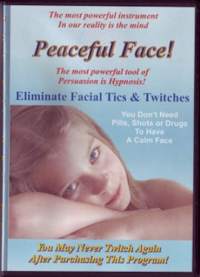
the developer of "Peaceful Face!" an
effective facial
tics and facial twitch hypnosis and NLP program. He also
offers a complete range of hypnotherapy CDs for
self-confidence, allergies,
weight
loss, and smoke
cessation.
Related
Articles
Banish
Facial Tics With NLP
Facial
Tics and How to Obliterate Them
Facial
Tics And Facial Twitch: How To Eliminate Them With Hypnosis
|
|