




|
|
How to Overcome Insomnia in 8 Quick Steps
Click here to email this
page to a friend. |
||
|
Insomnia
is one of the more common symptoms of stress and depression.
While clients come to my office with a wide range of
symptoms to eliminate, most of them have a sleep disturbance
in addition to the symptom they have come to eliminate.
Whether you have had a hard time falling asleep, or you fall
asleep promptly and then awaken later and are unable to fall
asleep again, you have insomnia.
THERE
ARE FOUR TYPES OF INSOMNIA
Many
people have had insomnia
of such long-standing that they also develop an irrational
fear or phobia of getting into bed. They are afraid to get
into bed because they expect to lie awake. This negative
expectancy will bring about insomnia all by itself. An
understanding of the human organism is the first prerequisite
in bringing about a cure to insomnia. No one has ever died from or become ill from lack of sleep. The body and mind will get at least the minimum amount of sleep that it needs, no matter what. If you lose some sleep one night, the next night you will get some additional sleep to make up the loss. We
all have an internal clock. This internal clock brings about
an apex of fatigue in cycles. Although the cycle is
different in each individual, it generally runs between four
and six hours. In other words, every four to six hours, you
will have an apex of fatigue, and this will be when it will
be easiest for you to fall asleep. After the apex of
fatigue, you will ex'perience a renewed feeling of energy
and at this time it will be quite difficult to fall asleep. Although subjects complain of not having slept a wink all night, it has been proven in sleep laboratories that we all sleep during the night. Sometimes the sub'ject feels that he has been lying awake thinking, but actually he has been sleeping lightly -and dreaming. Trying to fall asleep: There is a law of nature call'ed The Law of Reversed Effect. It says that if you try to do something, you will get the opposite. The harder you try, the more you will get the opposite. So, trying to fall asleep will insure that you will remain awake. It would be better for you to try to remain awake! Alcohol will put you to sleep: This may be true; as alcohol is a depressant. However, as soon as it wears off, you will abruptly awaken and it will be harder than ever to fall asleep. Sleeping pills can help: During sleep it is the dream phase of sleep in which you get your rest. Sleeping pills suppress the dream phase of sleep. That is why one generally awakens more tired than before going to sleep after using sleeping pills. You will get more rest by lying awake quietly than you will from nar'cotic induced sleep. In addition, one builds up a tolerance to this type of medication so that more and more is needed. In addition to the tolerance, an addic'tion to this type of medication is also likely. EFFECTING
A CURE 1.
Find out when your time of greatest fatigue is in the
evening. At least an hour before your time of greatest
fatigue, take a warm bath, slightly warmer than body
temperature, soak and relax for 20 minutes or so. (It is
important to note that a shower just won't do.) A bath is
strongly recommended. 2.
Have a warm beverage, preferably not coffee or tea. 3.
Discontinue thoughts of problems that you have, or
what needs to be done tomorrow. If you are worried about
forgetting what you have to do tomorrow, write it down. 4.
Stay away from stimulating thoughts and televi'sion
shows. If you must read, then read something that is boring. 5.
Reserve your bed for sleep. Do reading and televi'sion
watching from a chair only. 6.
Get into bed at least 20 minutes before your apex of
maximum fatigue. Once in bed, if worries begin to pop into
your mind, tell yourself, "I'll think about it
tomorrow, I'll think about it tomorrow". This will go a
long way toward eliminating excessive thoughts and can be
repeated several times. Do not try to make your mind blank.
Do not try to fall asleep. Just allow yourself to
rest. 7.
For Endogenous Insomnia, you should eliminate the
discomfort to the best of your ability. 8.
For Exogenous Insomnia, make the room as quiet as
possible. If your partner snores, you can move to another
room. Running a fan motor can also help in'duce sleep as it
will tend to cover up outside noises and the monotonous
drone of the fan generally proves to be very relaxing. HYPNOTIC
TREATMENT FOR PSYCHO-REACTIVE
AND
FUNCTIONAL INSOMNIA
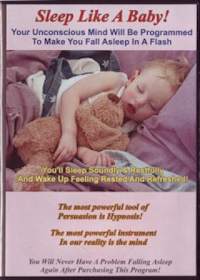
In addition to the steps outlined above, you will want to practicing self-hypnosis every day. To that end, Alan B. Densky has created his exceptionally powerful "Sleep Like A Baby!" program. This program combines together Traditional Hypnosis, Ericksonian Hypnosis, and NLP techniques, and it has produced a near 100% success rate.
It
is important to note that if you are doing self-hypnosis for
some other symptom, the insomnia will probably go away all
by itself within a week or two. In at least 75 percent of
the cases that I treat, insomnia dissipates without any
direct suggestions. If,
however, you have been working on another problem for a week
or two and your in'somnia has not gone away by itself, it
is recommended that you discontinue the hypnotic treatment
for the other problem at this time and work on the insomnia
instead. Work on one problem at a time. This does not mean that if you are on a diet, you should discontinue the diet. It merely means discontinue the hypnotic treatment for the diet until the insomnia has been eliminated.
A list of the common uses of hypnosis.
© 1982 By Alan B. Densky. This document may NOT be re-printed without permission. All Rights Reserved. We are happy to syndicate our articles to approved websites. Alan B. Densky, CH. is certified by the NGH, and he is an NLP Practitioner. He offers self-hypnosis for sleep disturbances. He hosts a FREE hypnosis article index on his Neuro-VISION Video Hypnosis & NLP website.
|
|||